How to open a CBCT without installing software: a practical online-viewer guide
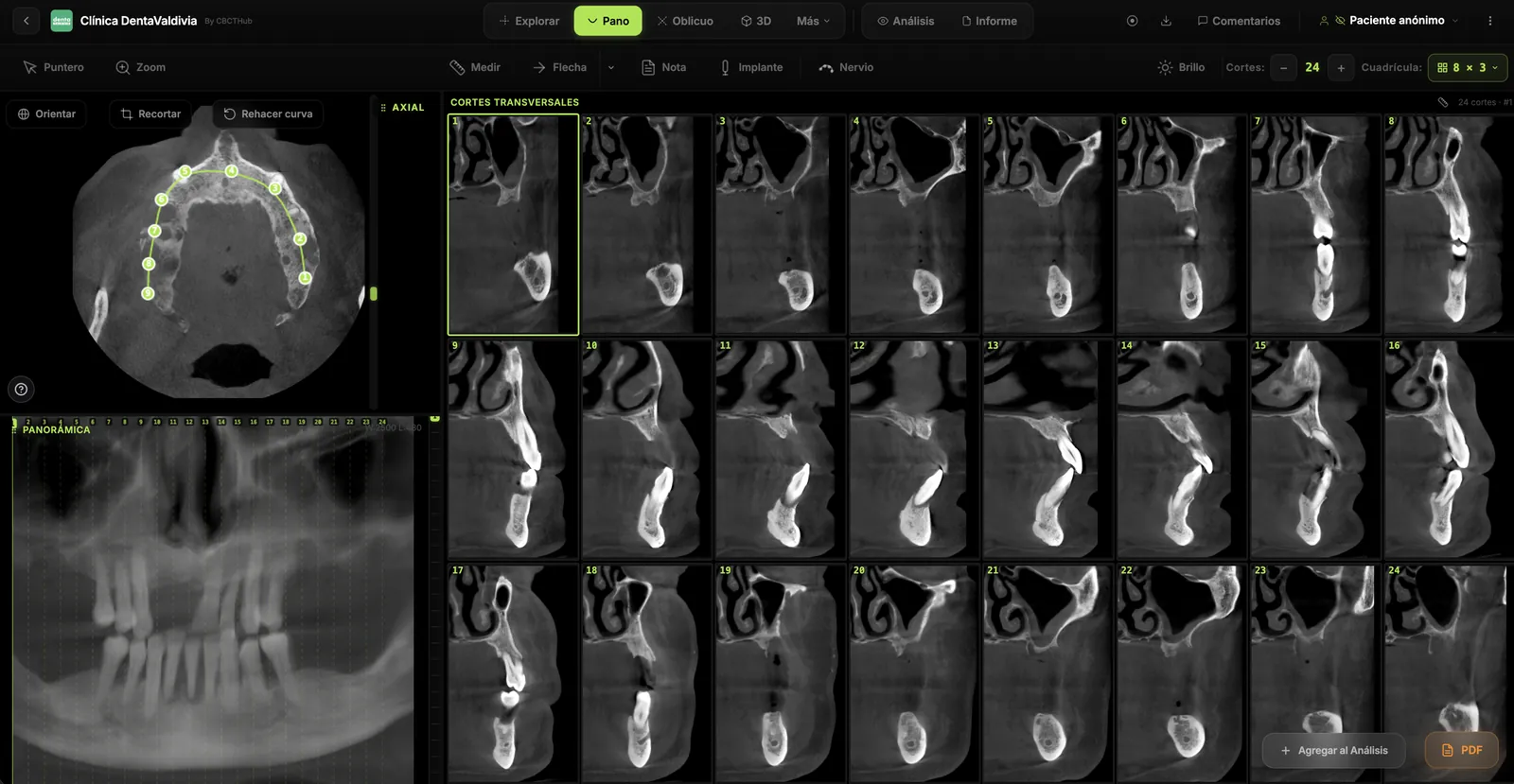
The CD arrives, or a 400 MB ZIP, or a link from the imaging centre. The patient is already in the chair; implant planning or endodontics cannot wait—and your computer does not have Romexis, CS 3D Imaging, or whatever viewer was burned onto the disc. There may be no optical drive, or the package only runs on Windows while you work on a Mac. This guide is the how: concrete steps to open the CBCT / DICOM volume today, without installing manufacturer software, using a browser-based viewer.
For the conceptual companion (what an online CBCT viewer is and when to prefer it over desktop), see Online CBCT viewer: what it is and when to use it in clinic. Here the focus is the operational workflow: prepare the folder, verify millimetre measurements, and recover when something fails.
What “open without installing” means
“Without installing” does not mean “without a standard.” It means:
- Not installing the manufacturer executable on that PC (nor buying a per-seat licence just to “open the CD”).
- Using standard DICOM (NEMA DICOM PS3): slice series with spatial calibration metadata—not a single-brand closed format.
- Opening in the browser (Chrome, Safari, Firefox, Edge): the volume loads and navigates in a tab; in modern designs reconstruction can run on your device (e.g. via WebAssembly) while the file travels encrypted.
It is not the same as opening JPEG screenshots on WhatsApp: you lose spatial context and often millimetre calibration. A Drive or WeTransfer link that only delivers files with no reading tool is also not enough. The clinical goal is to open the full volume, measure, and decide—not to improvise from screenshots.
SEDENTEXCT / Radiation Protection 172 and EADMFR basic principles stress that CBCT is indicated when the clinical question cannot be answered with lower-dose radiography, and that the full dataset should be appropriately evaluated. Opening the DICOM correctly is part of that responsibility; the viewer alone does not justify a new scan.
Three common inputs (and how to prepare them)
1. Physical CD / DVD
- Insert the disc (if you have a drive) or ask the centre for a digital copy: DICOM folder or ZIP via a secure link—not only the manufacturer auto-run viewer.
- Look for a folder with many
.dcm/.dicom/.imafiles, often next to a DICOMDIR. - Skip the brand
.exeor installer first: that is the path you want to avoid without a licence or OS match. - Copy the full folder to local disk (SSD preferred). Do not half-open from a slow CD: read errors and incomplete series are common.
2. ZIP or loose .dcm folder
- Extract the ZIP completely to a local folder. Do not drag only a few files if the series has hundreds of slices.
- Keep the structure: there may be subfolders per series (CBCT, scout, reconstructions). For the 3D volume you usually need the main thin-slice series.
- If the ZIP is hundreds of MB, check integrity (expected size vs truncated download) before blaming the viewer.
3. Shared link from the imaging centre
- Simplest path: open the link in the browser—often without installing or, in well-designed flows, creating an account just to view.
- Treat the link as clinical data: do not post it on social media or forward it to unauthorised lists.
- If the link asks for a PIN or expires, note it in the chart; if it will not open, ask the centre to resend or re-export as DICOM.
Step by step: from files to measurable MPR
Step 1 — Confirm you have usable DICOM
Quick checklist:
- [ ] Many image files (often hundreds), not only PDF/JPEG.
- [ ] Typical extensions:
.dcm,.dicom,.ima, or extensionless files inside a DICOM folder. - [ ] A DICOMDIR (optional but helpful) or Patient/Study/Series metadata.
- [ ] The centre or report confirms CBCT / cone-beam modality.
If you only received a PDF report with four captures, you do not have the volume. Request a standard DICOM re-export.
Step 2 — Open in a browser DICOM viewer
Generic flow (brand-agnostic if the unit exported standard DICOM):
- Open the viewer in the browser (laptop or desktop recommended for full tools).
- Drag the DICOM folder or full ZIP, or open the shared link.
- Wait for the series to load. Large volumes take time depending on network and disk; do not close the tab mid-load.
- Confirm you see MPR: synchronised axial, sagittal and coronal. If you only see one fixed 2D image, you likely loaded the wrong series.
Carestream, Planmeca, Vatech, Sirona, Morita, NewTom and other units that export standard DICOM are typically readable by a multi-brand viewer. If the centre delivered only an embedded proprietary package, go to Step 5 (re-export).
Step 3 — Verify calibration and one millimetre measurement
Before you plan:
- Scroll dozens of slices: is anatomy coherent (arch, sinus, condyles)?
- Enable the millimetre distance tool.
- Measure a known or plausible distance (e.g. crestal width on a cross-section, or a reference diameter you already know for the case).
- If units appear as pixels without mm, or distances look absurd, do not trust that session: DICOM spacing may be missing. Request a re-export with intact spatial calibration.
Step 4 — Minimum tools to decide today
For most same-day clinical decisions you need at least:
- Stable MPR
- Cross-sections / curve panoramic when planning implants
- Oblique reformats (endo, spatial relationships)
- Millimetre measurements; often also notes or angles
- When helpful: implant simulation, inferior alveolar nerve tracing, 3D view
You do not need the full manufacturer suite to “view and measure” standard DICOM. Be realistic: highly brand-specific modules may still be required (see below).
Step 5 — If it fails: request standard DICOM re-export
Ask the centre, specifically:
- Export the study as standard DICOM (folder or ZIP), not only the auto-run viewer.
- Include the full CBCT series (not only captures).
- Prefer delivery by link or secure ZIP, not only CD.
- Confirm pixel spacing / slice thickness travel in the metadata.
Clinical checklist: open the volume, not the screenshots
Use this when the CBCT is already justified (ALADA: as low as diagnostically acceptable) and you must act:
| Scenario | What to open / verify | Common failure |
|---|---|---|
| Crestal implant site | Cross-sections + height/width in mm; distance to risk structures | Planning from 2D panoramic alone or two report captures |
| IAN / mandibular canal proximity | Full volume + tracing or follow-through on slices; safety mm | Trusting an uncalibrated screenshot |
| Endodontics (extra canal, fracture, lesion) | Oblique + zoom; FOV that answers the question | WhatsApp JPEGs without spatial orientation |
| Third molar / surgery | Root–canal / cortical relationships on MPR | Deciding from one isolated out-of-context slice |
AAOMR and European guidance emphasise responsibility for evaluating the dataset appropriately. Opening the full volume is the first practical step of that responsibility.
When manufacturer desktop is still needed
Stay on (or request) brand software when:
- The protocol requires a specific proprietary module.
- You need calibrations or tools your web viewer does not offer for that case.
- Centre policy forbids any external storage or delivery.
- You already have a licensed workstation and are not sharing with third parties that day.
For viewing, measuring and sharing standard DICOM in many real workflows, the browser is enough. An online viewer is not “every desktop feature in one tab.”
Privacy basics (no legal overclaim)
When moving CBCT over the internet:
- Ask whether there is TLS in transit and encryption at rest (typical design: AES-256).
- Ask where reconstruction happens (local browser vs server).
- Treat the link as clinical information.
- Follow local policies, consent and your country’s rules; technical encryption does not replace the legal framework.
FAQ
Can I open the CBCT only with the CD installer?
Sometimes, if the OS and licence allow it. In practice it fails due to missing drives, Mac/Windows mismatch, or licensing. Prefer DICOM + a cross-platform viewer to avoid that bottleneck.
What if I only received JPEGs or a PDF?
Request the volume as DICOM. Captures support the report; they do not replace the dataset for confident millimetre measurement.
Do I need an account to open a centre link?
In well-designed flows, no: open in the browser without installing or signing up. An account is usually optional if you want your own history or to upload your own studies.
Does it work on a phone?
Many delivery pages open on any device, but full workstation tools are usually designed for laptop or desktop.
Does the viewer justify ordering more CBCT?
No. Indication follows clinical judgement and guidance (SEDENTEXCT/EADMFR, ALADA). Software helps open an already justified study; it does not justify extra dose for convenience.
What if the ZIP will not load or MPR looks incomplete?
Check download completeness, extract locally, try another folder/series inside the ZIP, and if needed request a standard DICOM re-export. Do not plan surgery on a truncated series.
References
- European Commission. Radiation Protection No 172: Cone Beam CT for Dental and Maxillofacial Radiology — Evidence-based Guidelines (SEDENTEXCT). 2012. Available at sedentexct.eu / ec.europa.eu.
- European Academy of DentoMaxilloFacial Radiology (EADMFR). Basic Principles for Use of Dental Cone Beam CT (consensus; incorporated in RP 172). sedentexct.eu.
- American Academy of Oral and Maxillofacial Radiology (AAOMR). Position / executive statements on CBCT use, operator responsibility and interpretation of the full dataset. aaomr.org.
- Jaju PP, Jaju SP. Cone-beam computed tomography: Time to move from ALARA to ALADA. Imaging Sci Dent. 2015;45(4):263-265. DOI: 10.5624/isd.2015.45.4.263
- Benavides E, et al. Optimizing radiation safety in dentistry: Clinical recommendations (ADA Council on Scientific Affairs). JADA. 2024;155(4). ALADA / CBCT justification.
- National Electrical Manufacturers Association (NEMA). Digital Imaging and Communications in Medicine (DICOM) Standard, PS3. dicom.nema.org.
Note: educational content. It does not replace clinical judgement, formal radiological reading, or legal advice on data protection in your jurisdiction.
If you need to open a CBCT DICOM in the browser—measure in mm and share without installing each brand’s software—try an online dental DICOM viewer such as CBCTHub. For “what it is / when to use it,” see Online CBCT viewer: what it is….
Try CBCTHub for free
Upload, view, and share DICOM scans in the cloud. Nothing to install.
Create free accountRelated articles
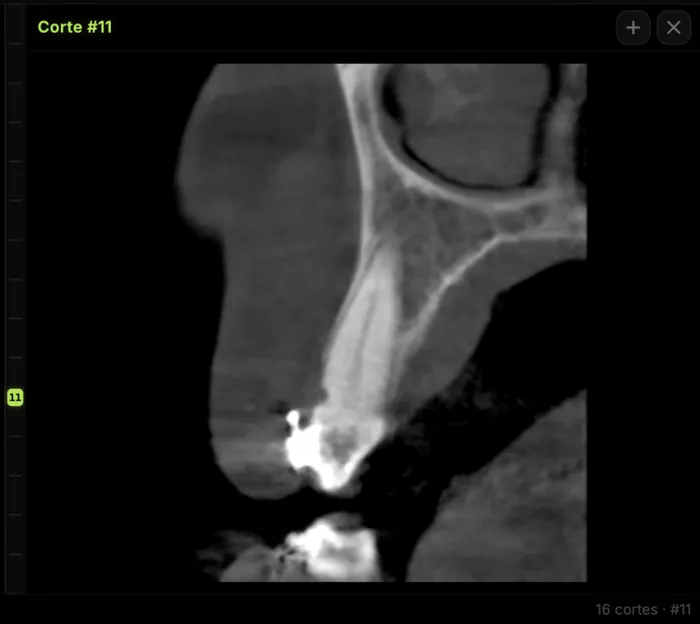
Mandibular canal and inferior alveolar nerve on CBCT: anatomy, variants, and pre-surgical measurement
Locate the mandibular canal and IAN on CBCT: mental loop, bifid/retromolar canal, measurement checklist, and when to escalate from panoramic (ALADA).
Online CBCT viewer: what it is and when to use it in clinic
What an online CBCT viewer is, when to use it vs desktop or CD, DICOM tools (MPR, measurements, share link) and basic privacy in clinic.
Best CBCT Viewers 2026: Complete Comparison of 10 Dental Imaging Software Options
In-depth comparison of the best CBCT viewers for dental imaging in 2026. Cloud-based and desktop options, pricing, features, and best-fit scenarios.