Online CBCT viewer: what it is and when to use it in clinic
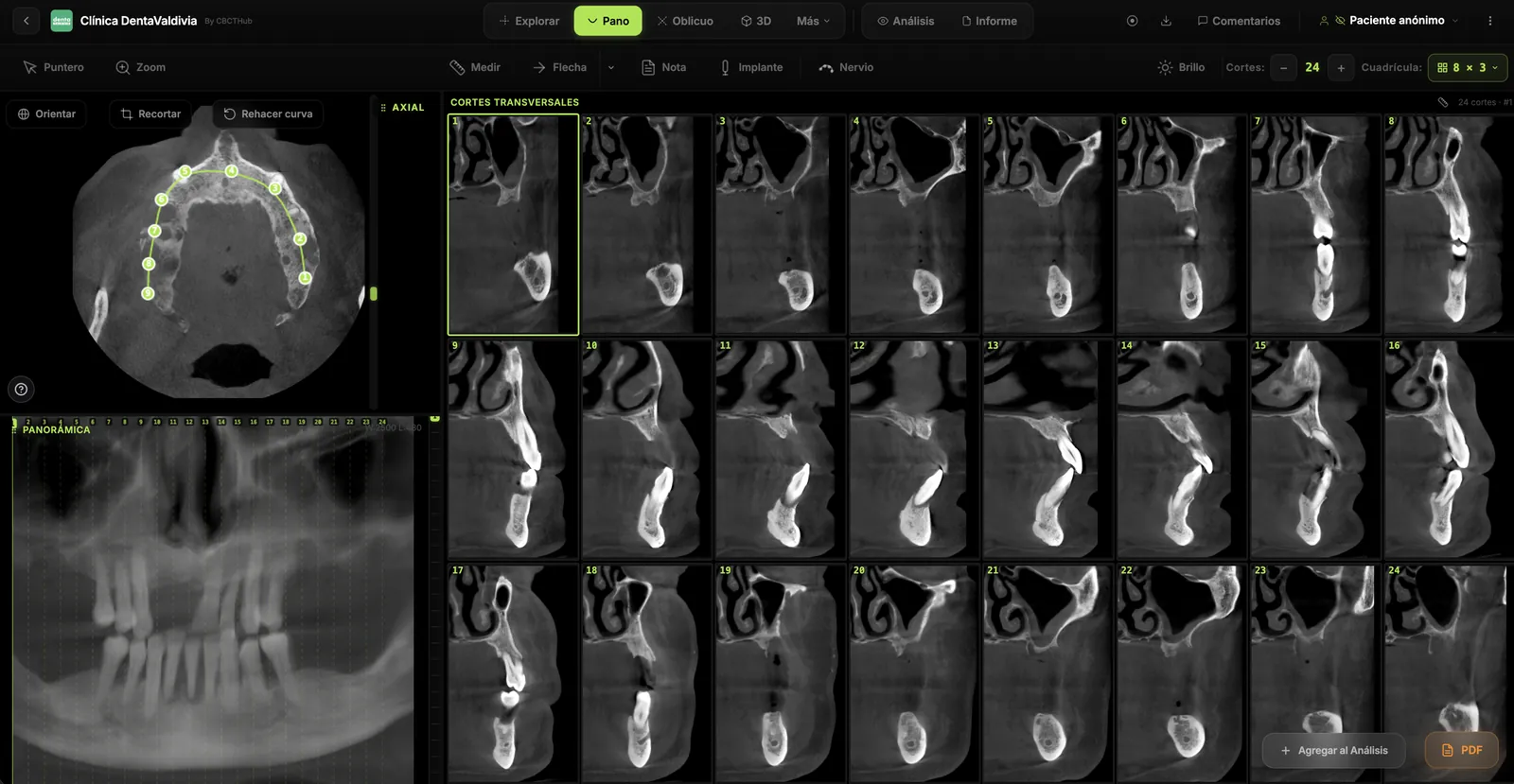
An online CBCT viewer is software that opens cone-beam CT volumes in the browser from DICOM files, without installing a manufacturer program on every computer. It lets you review the volume in MPR planes, measure in millimetres, plan, and deliver the study via a shared link. In daily clinic it solves a concrete problem: the CD or ZIP folder arrives, but the dentist does not have that brand’s viewer, there is no optical drive, or the heavy file gets lost across email and WeTransfer.
This article explains what a web-based dental DICOM viewer is, when to prefer it over desktop software or a CD, which minimum capabilities it should offer, and how it fits the flow between imaging centre, radiologist, and referring dentist. The focus is clinical and practical; a product example appears at the end without inventing features.
What an online CBCT viewer is (and is not)
Cone-beam computed tomography (CBCT) produces a dentomaxillofacial 3D volume in one rotation, exported as a DICOM series. That format is the common language across Carestream, Planmeca, Vatech, Sirona, Morita, NewTom and other units that export standard DICOM. An online CBCT viewer reads that series in the browser and lets you navigate the volume like a workstation: axial, sagittal, coronal, derived reconstructions, and measurement tools.
It is not the same as:
- A gallery of JPEG screenshots on WhatsApp (spatial context and calibration are lost).
- A Drive or WeTransfer link that only delivers files with no reading tool.
- Proprietary software installed only on the cone-beam PC or on a seat licensed per brand.
It also does not replace clinical justification of the exam. European guidance (SEDENTEXCT / Radiation Protection 172) and EADMFR basic principles stress that CBCT is indicated when the question cannot be answered with lower-dose radiography, and that the full volume should be appropriately evaluated. The viewer is the means to open and work an already justified exam; it does not justify a scan by itself.
Online vs desktop vs CD: three ways to deliver the same exam
Manufacturer desktop software
Romexis, Invivo, OnDemand3D, CS 3D Imaging and similar products offer deep modules tied to each brand’s workflow. They remain useful when you need manufacturer-specific features, advanced calibrations, or a fully local flow with no cloud upload. The trade-off is installation, updates and often per-seat licensing: the remote radiologist ends up using remote desktop into the centre’s workstation.
CD / DVD / ZIP folder
Still common in many clinics. The patient loses the disc, the office has no reader, or 600 .dcm files arrive without a compatible viewer. The dentist improvises “open with whatever is there” and the study may never get a full read. For the centre, re-burning the same exam costs front-desk time and risks the wrong version.
Browser CBCT viewer
The exam is uploaded once (DICOM folder or ZIP). Whoever receives a link opens it in Chrome, Safari, Firefox or Edge, often without installing software or creating an account. Reconstruction can run on the user’s device (for example via WebAssembly), so pixels are processed locally while the file travels encrypted. For viewing, measuring and sharing in most clinical flows, that covers the essentials. Be honest: highly specific manufacturer modules may still be needed; a web viewer is not “every desktop feature in one tab”.
When to use it in clinic: scenario checklist
Use (or request) an online CBCT viewer when the bottleneck is access and collaboration, not only acquisition:
- Implant dentistry. You need cross-sections, crestal–anatomy distances in mm and often implant simulation plus nerve tracing as a safety reference. The patient or centre sent the study and you want to measure today, not tomorrow when “someone installs the viewer”.
- Endodontics. Suspected extra canal, fracture or periapical lesion: oblique cuts, zoom and measurements matter more than a PDF of screenshots. CBCT here is usually selective (ALADA: as low as diagnostically acceptable).
- Surgery / third molars / referral. The oral surgeon or specialist opens the centre’s link to the full volume and discusses findings without trading loose screenshots.
- Radiologist reporting off-site. They work from their own computer, review MPR/panoramic/oblique and deliver report + exam without RDP to a fixed machine.
- Imaging centre with many referrers. Replace CDs with a branded link by email or WhatsApp, and know whether the dentist opened the study.
- Quick interconsultation. A colleague in another city: a link to the full exam beats a 400 MB ZIP and three uncalibrated captures.
Stay on desktop when: the protocol requires a specific proprietary module, centre policy forbids any external storage, or you always work on the same already-licensed workstation and do not share with third parties.
What a good online dental DICOM viewer should allow
Regardless of brand, a useful selection checklist:
- MPR (axial, sagittal, coronal) with smooth volume navigation.
- Curve-based panoramic reconstruction and a series of cross-sectional cuts perpendicular to the arch.
- Oblique reformats with free rotation (canals, fractures, spatial relationships).
- Millimetre measurements (distances; in many workflows also angles and slice notes).
- Common planning tools: inferior alveolar nerve tracing, implant simulation, 3D reconstruction when it helps the patient or the plan.
- DICOM or ZIP upload compatible with standard DICOM from multiple brands, without manual conversion.
- Share by link (email / WhatsApp / chart), ideally without the recipient installing anything or creating an account just to view.
- Basic security: encryption in transit (TLS) and at rest; local reconstruction when the architecture allows it.
As a product example that matches this browser profile, CBCTHub is an online dental DICOM viewer: reconstruction runs on the user’s device via WebAssembly; the person who receives the link can open it without an account or installation; it includes MPR, curve panoramic, cross-sections, oblique, mm measurements, implant, nerve tracing, 3D and notes/angles; it accepts DICOM/ZIP from units that export standard DICOM (Carestream, Planmeca, Vatech, Sirona, Morita, NewTom, among others). Typical use splits three ways: dentist opening what was sent, radiologist in the reporting flow, and centre delivering a branded link (Max/Ultra plans). It does not claim to replace every manufacturer desktop module; it does cover view, measure and share in many real workflows.
Security and data: essentials without legal overclaim
When moving CBCT over the internet, ask at least:
- Do files travel over TLS and sit encrypted at rest (e.g. AES-256)?
- Where does volume reconstruction happen (local browser vs server)?
- Who can open the link, and is access logged?
- Is a data-processing agreement available if your centre or jurisdiction requires it?
A typical dental web-viewer design combines AES-256 at rest, TLS in transit and reconstruction in the user’s browser. That reduces processing on third-party infrastructure, but does not replace local privacy policies, patient consent or your country’s rules. Treat the link as clinical information: do not post it on open social media or forward it to unauthorised lists.
FAQ
Does an online CBCT viewer always replace manufacturer software?
Not always. For viewing, measuring and sharing standard DICOM, it is often enough. If you depend on a specific proprietary module, you may still need the desktop app.
Does the dentist need an account to open what the centre sends?
In well-designed delivery flows, no: the recipient opens the link in the browser without installing or signing up. Creating an account is usually optional (e.g. if you want your own history or to upload your own studies).
Does it work with any cone-beam brand?
If the unit exports standard DICOM, a multi-brand viewer should open it. Confirm with a test study from your usual machine.
Is it “always free and unlimited”?
Do not assume that. There is often a free plan with limits (for example a number of your own exams). Opening a shared link is different from uploading and storing unlimited volumes.
Can I use it on a phone?
Many delivery pages open on any device, but full workstation tools are usually designed for laptop or desktop.
Does the viewer justify ordering more CBCT?
No. Image acquisition still follows clinical judgement and guidance such as SEDENTEXCT/EADMFR and the ALADA approach: CBCT when it changes management, with an appropriate FOV/protocol—not because the software is convenient.
References
- European Commission. Radiation Protection No 172: Cone Beam CT for Dental and Maxillofacial Radiology — Evidence-based Guidelines (SEDENTEXCT). 2012. Available at sedentexct.eu / ec.europa.eu.
- European Academy of DentoMaxilloFacial Radiology (EADMFR). Basic Principles for Use of Dental Cone Beam CT (consensus; incorporated in RP 172). sedentexct.eu.
- American Academy of Oral and Maxillofacial Radiology (AAOMR). Position / executive statements on CBCT use, operator responsibility and interpretation of the full dataset. aaomr.org.
- Jaju PP, Jaju SP. Cone-beam computed tomography: Time to move from ALARA to ALADA. Imaging Sci Dent. 2015;45(4):263-265. DOI: 10.5624/isd.2015.45.4.263
- Benavides E, et al. Optimizing radiation safety in dentistry: Clinical recommendations (ADA Council on Scientific Affairs). JADA. 2024;155(4). ALADA / CBCT justification.
- National Electrical Manufacturers Association (NEMA). Digital Imaging and Communications in Medicine (DICOM) Standard, PS3. dicom.nema.org.
Note: educational content. It does not replace clinical judgement, formal radiological reading or legal advice on data protection in your jurisdiction.
If you need a browser DICOM CBCT viewer to open, measure and share by link, try CBCTHub. Imaging centres: see also branded delivery at centros radiológicos. More articles: blog.
Try CBCTHub for free
Upload, view, and share DICOM scans in the cloud. Nothing to install.
Create free accountRelated articles
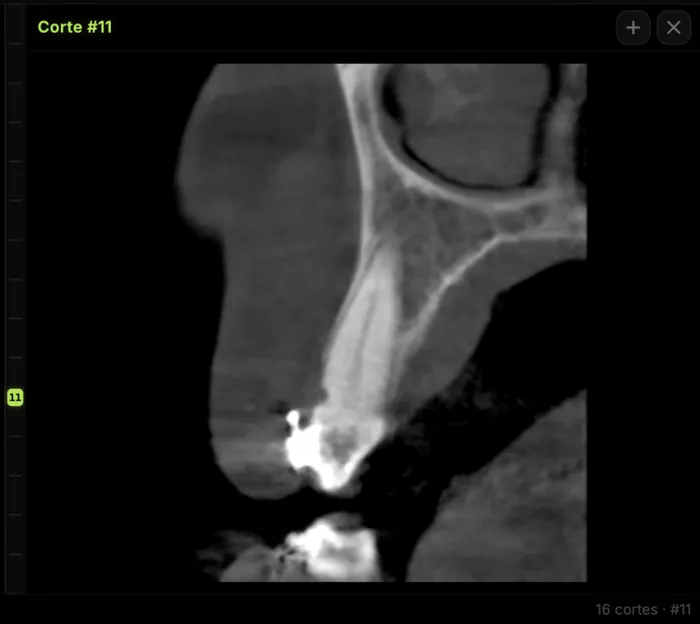
Mandibular canal and inferior alveolar nerve on CBCT: anatomy, variants, and pre-surgical measurement
Locate the mandibular canal and IAN on CBCT: mental loop, bifid/retromolar canal, measurement checklist, and when to escalate from panoramic (ALADA).
How to open a CBCT without installing software: a practical online-viewer guide
You got a CD, ZIP, or link with a CBCT and no manufacturer viewer. How to open the DICOM in the browser, measure in mm, and what to do when it fails.
Best CBCT Viewers 2026: Complete Comparison of 10 Dental Imaging Software Options
In-depth comparison of the best CBCT viewers for dental imaging in 2026. Cloud-based and desktop options, pricing, features, and best-fit scenarios.