Free DICOM viewer: 7 options compared in 2026
· Updated

If you receive DICOM studies (CBCT, CT, MRI) and need a viewer without paying for a license, there are good options in 2026. This is an honest comparison of 7 free viewers for dental and medical use, plus one cloud option for delivery.
1. RadiAnt DICOM Viewer (Windows, free demo)
One of the most popular viewers on Windows. Technically commercial but the demo runs indefinitely with some limitations.
- OS: Windows.
- Strong at: speed, MPR, MIP, measurement tools.
- Limitations: demo shows a banner at launch; commercial use requires a license.
- Ideal for: Windows radiologists who need a fast viewer.
2. Horos (macOS)
Open-source fork of OsiriX for macOS. One of the best options for Mac.
- OS: macOS.
- Strong at: Mac performance, 3D MPR, active community.
- Limitations: Mac only; install sometimes needs security overrides.
- Ideal for: dentists and radiologists on Mac.
3. 3D Slicer (multi-OS, open source)
The most powerful and complete of the free viewers. Used in advanced medical research.
- OS: Windows, macOS, Linux.
- Strong at: segmentation, modality-specific modules, community extensions.
- Limitations: steep learning curve; technical UI.
- Ideal for: research, complex planning, advanced users.
4. OnDemand3D Free (DentalApp)
The free version of the most-used dental CBCT software. Surprisingly complete.
- OS: Windows.
- Strong at: dental CBCT, reconstructed panoramic, basic cephalometry.
- Limitations: Windows only; implant and guide features are paid.
- Ideal for: dentists diagnosing CBCT scans in their practice.
5. Weasis (multi-OS, open source)
Open-source DICOM viewer developed in Switzerland, used by several European hospitals.
- OS: Windows, macOS, Linux.
- Strong at: well-implemented DICOM standard, hospital PACS integration.
- Limitations: less polished UI; oriented to hospital use.
- Ideal for: clinical environments with a DICOM PACS server.
6. MicroDicom Viewer (Windows)
Lightweight and fast Windows viewer, free for non-commercial use.
- OS: Windows.
- Strong at: speed, simplicity, basic measurement tools.
- Limitations: commercial use requires license; no advanced MPR.
- Ideal for: opening occasional DICOM studies without 3D needs.
7. DicomPass or web DICOM viewers
Client-side DICOM viewers in the browser, no install. Several open-source projects exist.
- OS: any with a browser.
- Strong at: zero install, multi-OS.
- Limitations: limited performance on large volumes; no storage.
- Ideal for: opening a one-off DICOM without installing anything.
What about CBCTHub? When to pick it over a local viewer
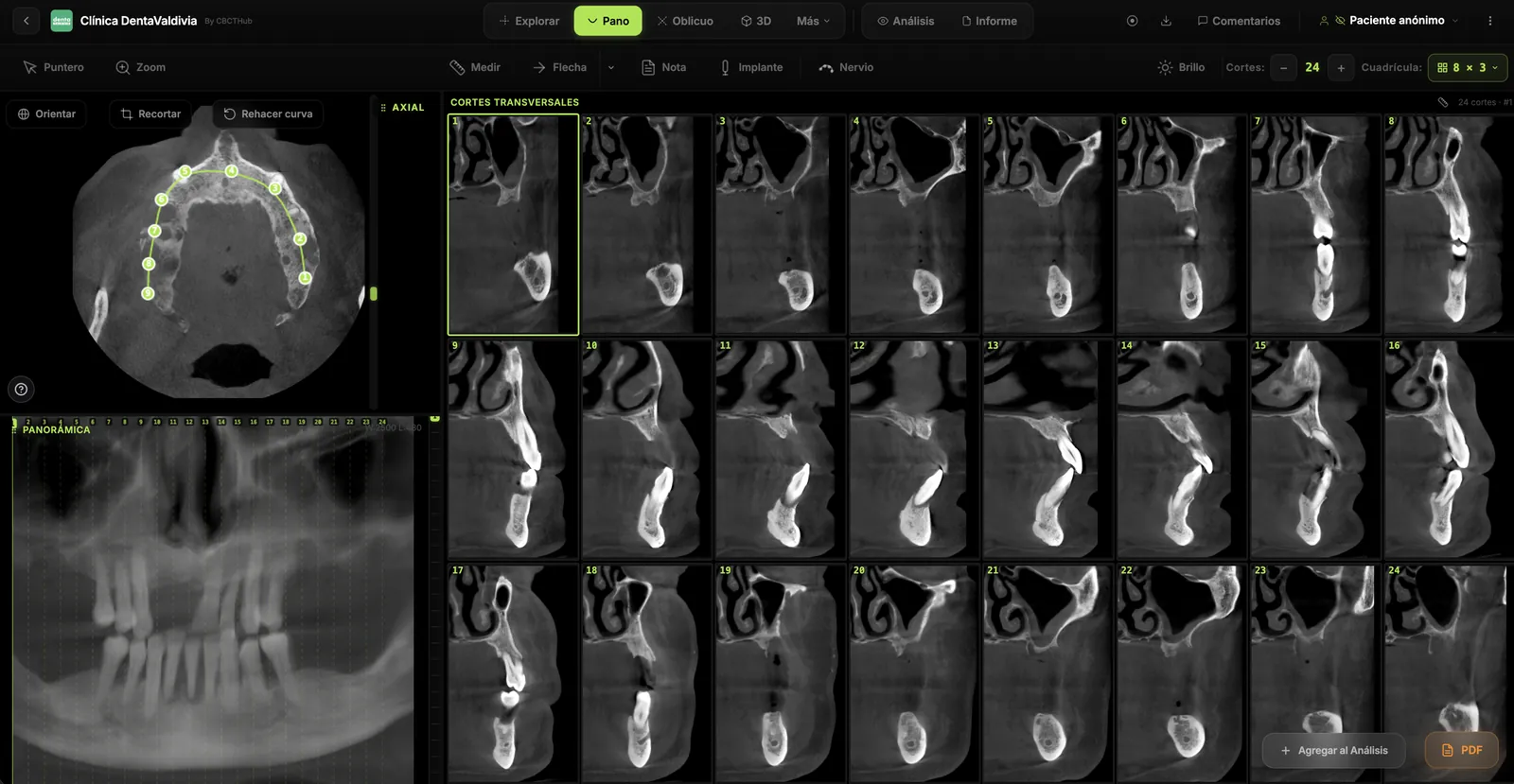
CBCTHub is not a viewer to open an isolated DICOM from your machine. It is a cloud platform to store, organize and share studies. But its online 3D viewer is comparable to local viewers on basic features and beats almost all of them at:
- Runs on any device (Mac, PC, iPhone, Android, iPad).
- The patient or referrer opens it without installing anything.
- Branded with your center logo.
- Signed report templates.
- Free plan available to get started.
If you only need to diagnose occasionally: use one of the 7 above. If you need to deliver scans to referrers or patients with your brand: create a free CBCTHub account.
Quick summary
- Windows + personal diagnosis: OnDemand3D Free or RadiAnt demo.
- Mac: Horos.
- Multi-OS or research: 3D Slicer.
- Zero install in browser: web viewer or CBCTHub.
- External delivery to patients and referrers: CBCTHub.
Wrap up
In 2026 there are good free options for almost any case. The key is to separate two questions: what do you need to diagnose yourself, and what do you need to deliver to others. For local diagnosis, free viewers cover it. For delivery and branding, cloud always wins.
Try CBCTHub for free
Upload, view, and share DICOM scans in the cloud. Nothing to install.
Create free accountRelated articles
Browser DICOM viewer vs desktop: what works for CBCT in clinic
Open CBCT in the browser or install a desktop viewer? A clinical decision matrix: MPR performance, offline use, Mac/Windows mix, sharing without CDs, and when native software still wins.
Dental DICOM software: a checklist for choosing a CBCT viewer
Before adopting a dental DICOM or CBCT viewer in the clinic: checklist for interoperability, MPR, mm measurements, share without CD, privacy, and TCO.
How to open a CBCT without installing software: a practical online-viewer guide
You got a CD, ZIP, or link with a CBCT and no manufacturer viewer. How to open the DICOM in the browser, measure in mm, and what to do when it fails.