Assessing Periodontal Bone Loss with CBCT Imaging

· Updated
Limitations of 2D Periodontal Assessment
Conventional radiographs have been the standard for assessing periodontal bone loss. But they have significant limitations: they only show mesial and distal bone levels (the buccal and lingual bone is hidden by superimposition), they can overestimate or underestimate bone loss depending on projection angle, and they cannot characterize the 3D morphology of infrabony defects.
CBCT periodontal imaging overcomes all of these limitations by providing a complete three-dimensional view of the alveolar bone around every tooth.
What CBCT Reveals That 2D Cannot
Buccal and Lingual Bone Levels
The most significant advantage of CBCT in periodontics is visualization of buccal and lingual bone plates. These are the first cortices to be affected in many periodontal conditions but are completely invisible on periapical and panoramic radiographs. CBCT cross-sections clearly show dehiscences, fenestrations, and the exact height of buccal/lingual bone.
Infrabony Defect Morphology
Periodontal regeneration procedures depend on the morphology of the bone defect. CBCT classifies infrabony defects as:
- 3-wall defects: Best prognosis for regeneration — bone surrounds the defect on three sides
- 2-wall defects: Good regenerative potential with proper technique
- 1-wall defects: Less predictable outcomes — may require different treatment approaches
This classification is impossible on 2D radiographs but straightforward on CBCT cross-sections.
Furcation Involvement
Assessing furcation defects on conventional radiographs is unreliable, especially for buccal furcations of upper molars and lingual furcations of lower molars. CBCT shows the exact extent of furcation involvement in all directions, helping periodontists decide between scaling, tunnel preparation, root resection, or extraction.
Crater Defects
Interdental craters — the most common form of periodontal bone loss — are difficult to assess in 2D because buccal and lingual walls overlap. CBCT clearly shows the depth and width of craters, their relationship to tooth roots, and the residual bone morphology.
Clinical Applications
- Treatment planning: Decide between regenerative, resective, or combined approaches based on true 3D defect morphology
- Prognosis assessment: Quantify remaining bone support around each tooth for long-term planning
- Implant site evaluation: Assess residual bone volume at extraction sites with periodontal involvement
- Monitoring: Compare sequential CBCT scans to track bone changes after periodontal treatment
When to Use CBCT for Periodontal Assessment
CBCT is not needed for routine periodontal probing and maintenance. Reserve it for complex cases: severe localized bone loss where the 3D morphology affects treatment choice, pre-surgical planning for regenerative procedures, furcation assessment before root resection, and cases where clinical findings don't match radiographic appearance.
Try CBCTHub for free
Upload, view, and share DICOM scans in the cloud. Nothing to install.
Create free accountRelated articles
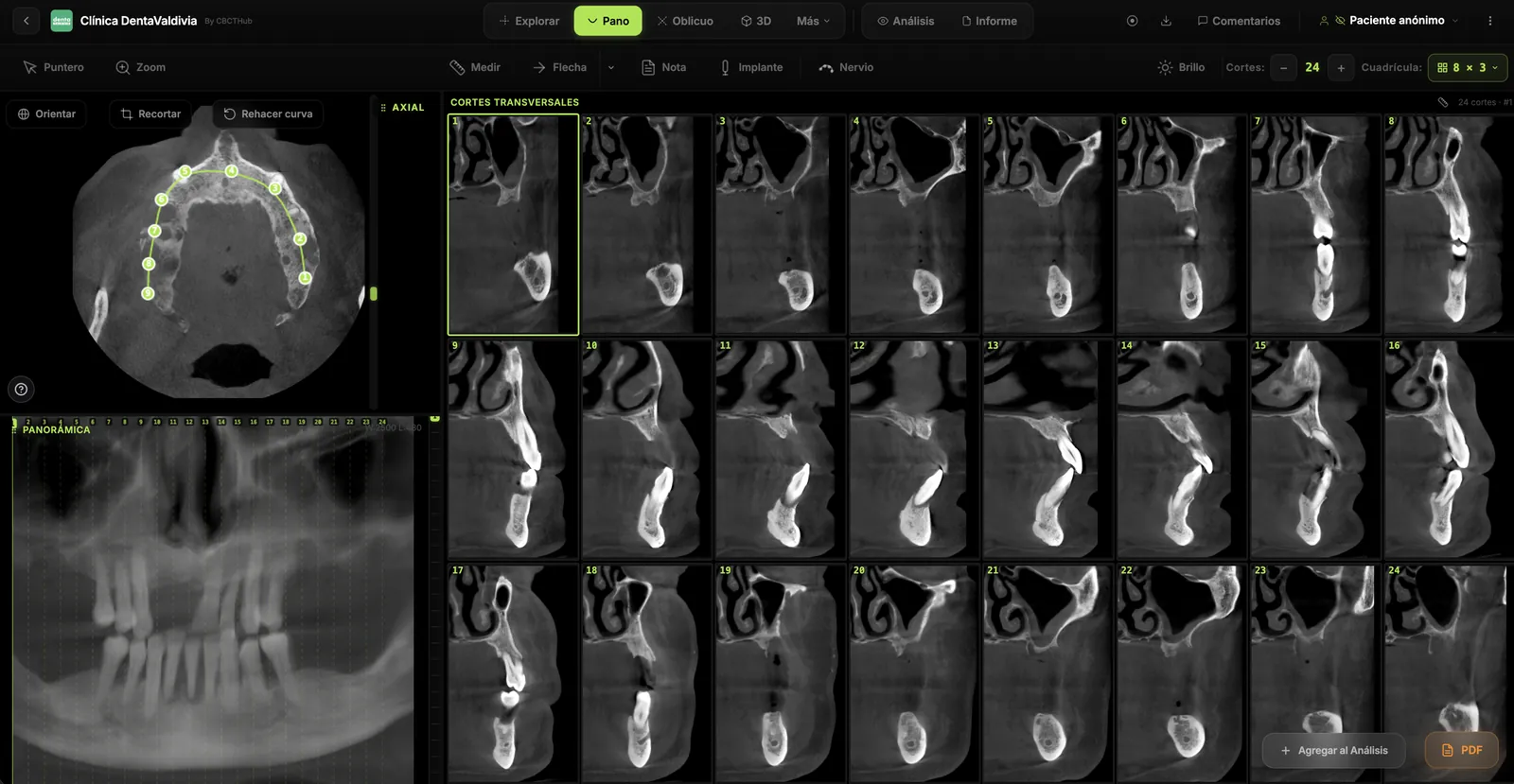
Browser DICOM viewer vs desktop: what works for CBCT in clinic
Open CBCT in the browser or install a desktop viewer? A clinical decision matrix: MPR performance, offline use, Mac/Windows mix, sharing without CDs, and when native software still wins.
How to open a CBCT without installing software: a practical online-viewer guide
You got a CD, ZIP, or link with a CBCT and no manufacturer viewer. How to open the DICOM in the browser, measure in mm, and what to do when it fails.
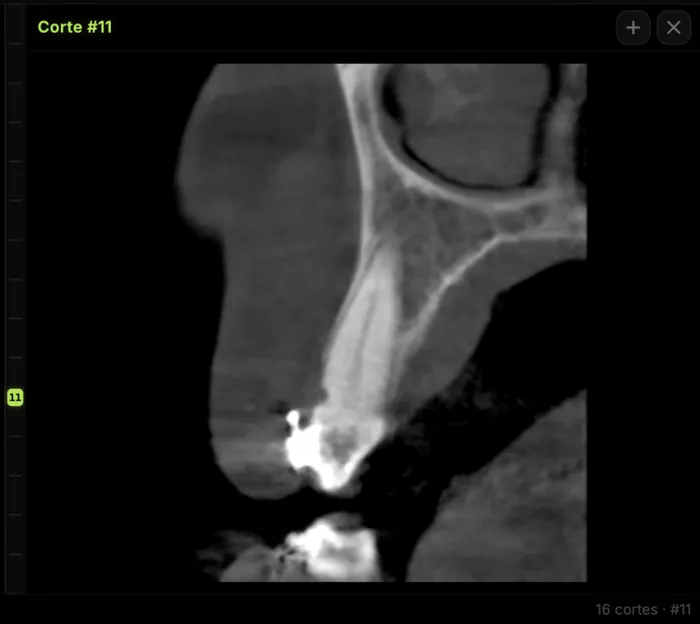
Mandibular canal and inferior alveolar nerve on CBCT: anatomy, variants, and pre-surgical measurement
Locate the mandibular canal and IAN on CBCT: mental loop, bifid/retromolar canal, measurement checklist, and when to escalate from panoramic (ALADA).