Remote CBCT Interpretation: Teleradiology Services for Dental Practices

What Is Dental Teleradiology?
Dental teleradiology is the practice of transmitting CBCT images electronically to a remote oral and maxillofacial radiologist for interpretation. The radiologist reviews the scan, identifies findings, and produces a comprehensive written report that the referring dentist uses to guide treatment decisions.
This service addresses a critical gap: most general dentists and specialists are trained to interpret CBCT scans for their specific clinical questions (implant bone volume, endodontic anatomy, third molar position), but they may lack training in systematic evaluation of the entire scan volume — potentially missing incidental findings like airway compromise, sinus pathology, vascular calcifications, or early-stage bone lesions.
Why Use a Teleradiology Reporting Service?
- Comprehensive interpretation: Oral radiologists are trained to evaluate every structure in the FOV, not just the area of clinical interest. Studies show incidental findings in CBCT scans are present in 25-65% of scans, many requiring follow-up.
- Liability protection: A formal radiology report from a board-certified radiologist provides documented interpretation that supports clinical decision-making and reduces medico-legal risk.
- Second opinion: For complex cases — unusual pathology, ambiguous findings, or treatment planning disagreements — a radiologist's independent interpretation provides valuable perspective.
- Patient care standard: The AAOMR recommends that all CBCT scans receive interpretation by a qualified individual. Teleradiology makes this feasible even for practices in rural areas without local radiologists.
How Teleradiology Workflow Works
A typical dental teleradiology workflow involves these steps:
- Step 1 — Acquisition: The dental practice acquires the CBCT scan using their scanner.
- Step 2 — Transmission: DICOM files are uploaded to the teleradiology provider's secure platform. This can be done via web upload, DICOM send to a cloud PACS, or through integration with practice management software.
- Step 3 — Interpretation: A board-certified oral and maxillofacial radiologist reviews the complete scan volume systematically, documenting findings.
- Step 4 — Report delivery: A written report is delivered to the referring dentist — typically within 24-48 hours for routine cases, or same-day for urgent requests. Reports may include annotated screenshots highlighting key findings.
- Step 5 — Consultation: Many services offer phone or video consultation for complex cases where the referring dentist wants to discuss findings and implications.
What a CBCT Radiology Report Includes
A comprehensive CBCT radiology report typically covers the dentition and supporting structures, maxillary sinuses, TMJs, airway, cervical spine (if in FOV), soft tissue calcifications (lymph nodes, carotid artery), any pathology or incidental findings, and clinical correlation and recommendations.
Choosing a Teleradiology Provider
When selecting a dental teleradiology service, consider credentials (board-certified OMFR), turnaround time, report format and detail, HIPAA compliance, ease of image transmission, cost per report, and availability for consultations.
Streamlining with Cloud-Based Viewing
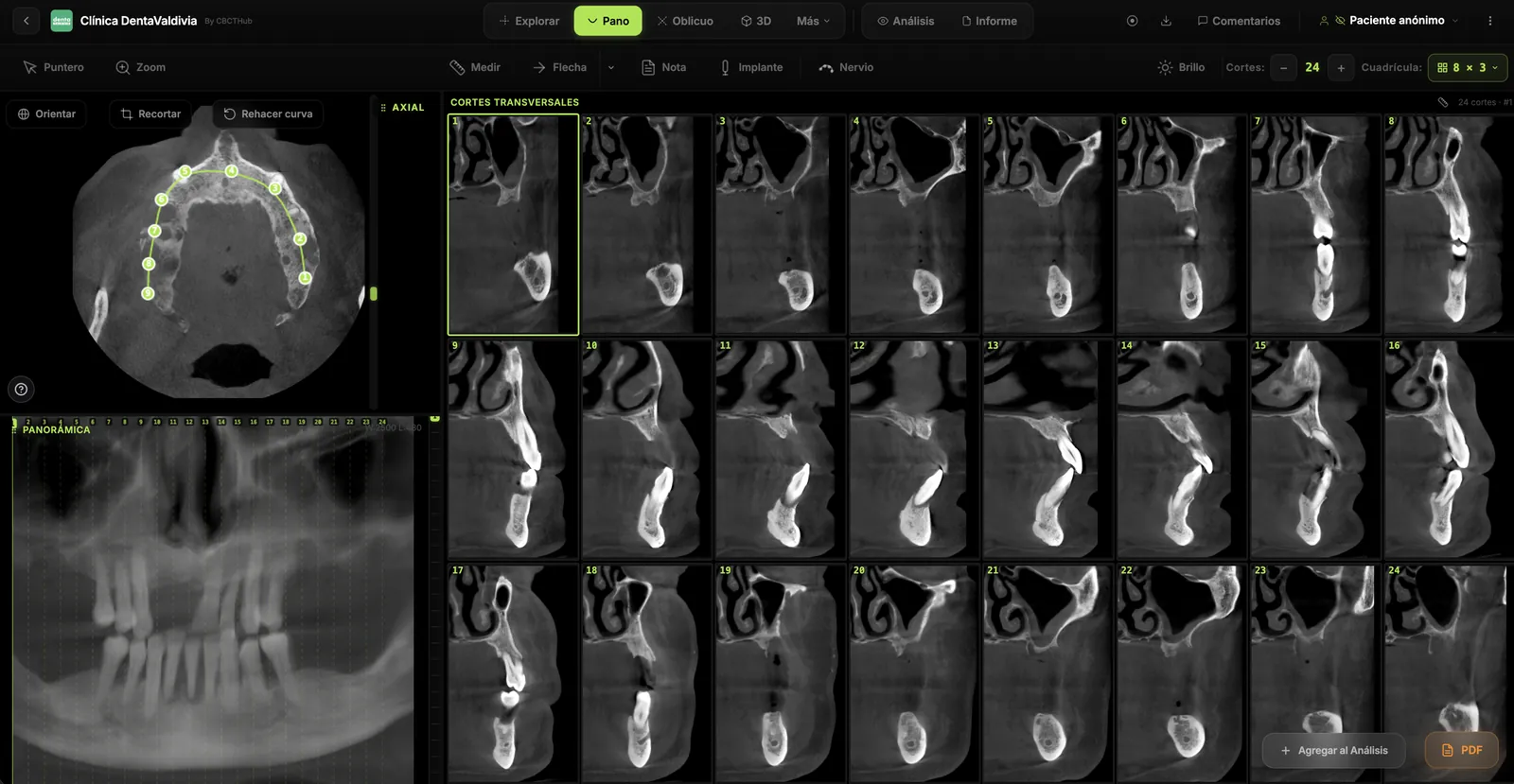
CBCTHub can simplify the teleradiology workflow. Instead of exporting DICOM files and uploading them to a separate platform, you can share a CBCTHub link directly with your teleradiology provider. They access the full CBCT dataset in their browser, review all MPR views, and use annotation and measurement tools — all without downloading files or installing software. This reduces turnaround time and eliminates file transfer headaches.
Try CBCTHub for free
Upload, view, and share DICOM scans in the cloud. Nothing to install.
Create free accountRelated articles
Dental CBCT in the cloud: day-to-day storage and sharing in clinic
What “CBCT in the cloud” means in clinic: store the original DICOM, access it from multiple chairs, and share with access control — without mistaking it for a full PACS or a WhatsApp ZIP.
Browser DICOM viewer vs desktop: what works for CBCT in clinic
Open CBCT in the browser or install a desktop viewer? A clinical decision matrix: MPR performance, offline use, Mac/Windows mix, sharing without CDs, and when native software still wins.
Dental DICOM software: a checklist for choosing a CBCT viewer
Before adopting a dental DICOM or CBCT viewer in the clinic: checklist for interoperability, MPR, mm measurements, share without CD, privacy, and TCO.