Pediatric CBCT Imaging: When Is It Safe and Necessary for Children?

The ALARA Principle in Pediatric Imaging
Children are more radiosensitive than adults — their developing tissues have a higher mitotic rate, and they have a longer lifetime for potential radiation effects to manifest. This makes the ALARA principle (As Low As Reasonably Achievable) especially critical when considering CBCT for pediatric patients.
The decision to order a CBCT scan for a child should always follow a clear clinical justification: the diagnostic benefit must outweigh the radiation risk, and the information cannot be obtained from lower-dose alternatives like periapical radiographs or panoramic imaging.
Accepted Indications for Pediatric CBCT
Professional organizations including the AAPD, AAE, and AAOMR recognize CBCT as appropriate for children in specific clinical scenarios:
- Impacted or ectopic teeth: Supernumerary teeth (mesiodens), ectopic canines, and impacted premolars. CBCT reveals exact 3D position, proximity to adjacent roots, and optimal surgical approach.
- Dental trauma: Root fractures, alveolar bone fractures, and luxation injuries that are ambiguous on 2D radiographs. CBCT changes the treatment plan in up to 62% of complex trauma cases.
- Cleft lip and palate: Assessment of alveolar bone defects before bone grafting, monitoring graft integration, and planning secondary surgeries.
- Airway assessment: Evaluation of adenotonsillar hypertrophy, upper airway dimensions in children with sleep-disordered breathing, and pre-surgical planning for adenotonsillectomy.
- Odontogenic pathology: Cysts (dentigerous, odontogenic keratocyst) and tumors (ameloblastoma, odontoma) that require precise localization for surgical planning.
- Orthodontic planning: Complex skeletal discrepancies, asymmetries, and cases requiring orthognathic surgery planning in adolescents.
Dose Reduction Strategies
When CBCT is indicated for a child, several techniques minimize radiation exposure:
- Smallest FOV possible: Use the smallest field of view that captures the area of interest. A 5×5 cm FOV delivers significantly less radiation than a full 16×13 cm scan.
- Pediatric protocols: Most modern CBCT units have child-specific exposure settings with reduced mA and kVp. Always select these protocols.
- Quick scan modes: Lower resolution, faster scan times reduce dose. For most pediatric indications, the slightly lower resolution is clinically acceptable.
- Thyroid collar: Always use a thyroid collar when the thyroid is not in the FOV — children's thyroid glands are especially radiosensitive.
Communicating with Parents
Parents often worry about radiation from dental X-rays. When recommending CBCT, explain the specific clinical benefit in simple terms, compare the dose to everyday radiation exposure (a dental CBCT scan delivers roughly the equivalent of 2–8 days of natural background radiation), and explain the dose reduction measures you'll use.
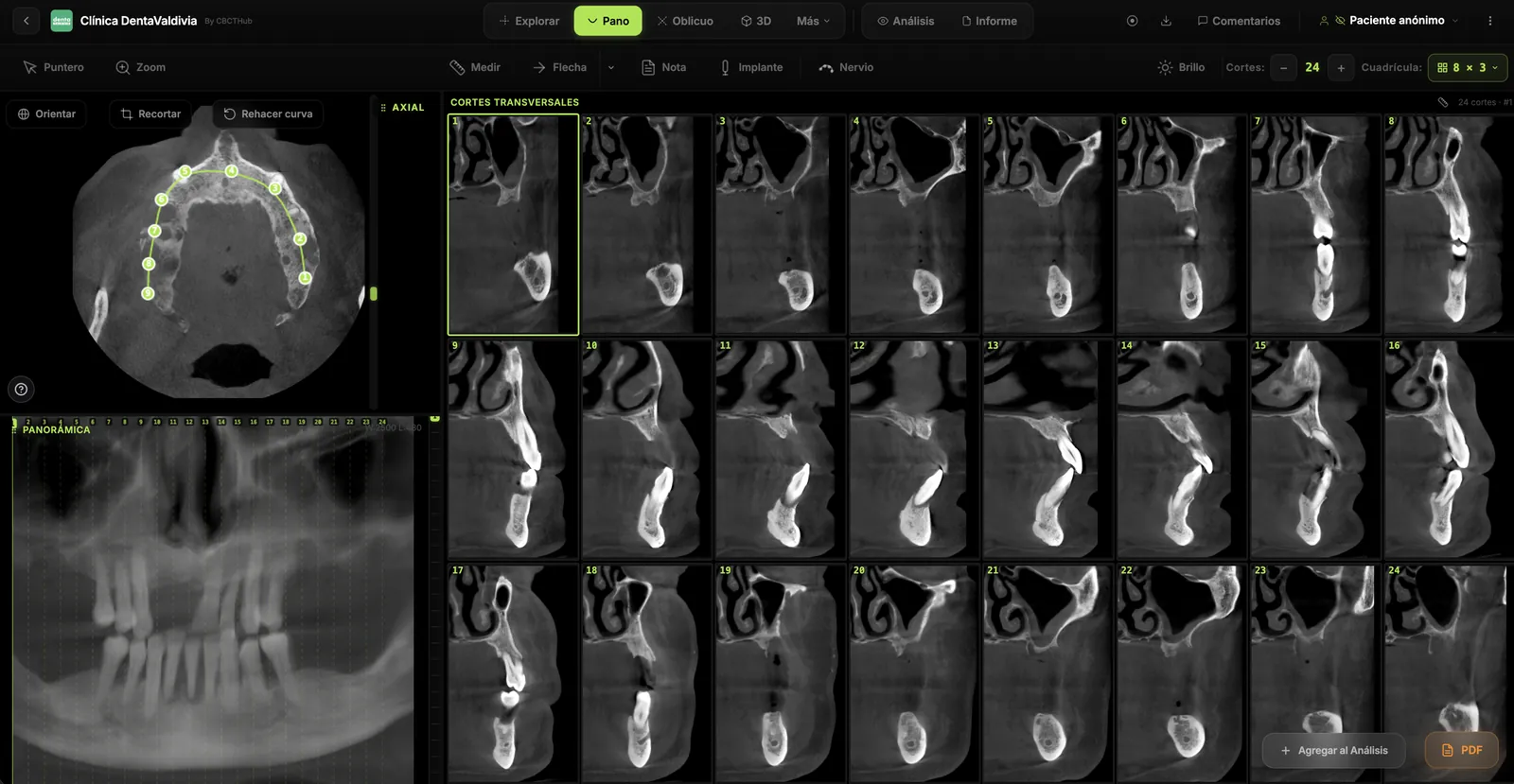
When sharing pediatric CBCT results with parents or referring specialists, a cloud-based viewer like CBCTHub lets them see the 3D images themselves — helping parents understand the clinical situation and building trust in the treatment plan.
Try CBCTHub for free
Upload, view, and share DICOM scans in the cloud. Nothing to install.
Create free accountRelated articles
Dental CBCT in the cloud: day-to-day storage and sharing in clinic
What “CBCT in the cloud” means in clinic: store the original DICOM, access it from multiple chairs, and share with access control — without mistaking it for a full PACS or a WhatsApp ZIP.
Browser DICOM viewer vs desktop: what works for CBCT in clinic
Open CBCT in the browser or install a desktop viewer? A clinical decision matrix: MPR performance, offline use, Mac/Windows mix, sharing without CDs, and when native software still wins.
Dental DICOM software: a checklist for choosing a CBCT viewer
Before adopting a dental DICOM or CBCT viewer in the clinic: checklist for interoperability, MPR, mm measurements, share without CD, privacy, and TCO.