CBCT for dental implant planning: a step-by-step guide
Placing dental implants without a preoperative CBCT is now the exception, not the rule. Every major society — AAOMS, ITI, EAO — recommends 3D imaging for implant planning in most indications. The question is not whether to acquire a CBCT, but how to use it efficiently once you have it.
This is a step-by-step practical guide for general dentists and implantologists. It assumes you have the scan; it walks through what to measure, what to look for, and how to get from pixels to a surgical plan.
Step 1: acquire the right scan
Before the patient sits down, know what you need.
- Single implant: 5×5 cm FOV centered on the site, including one neighbor on each side and the inferior alveolar canal if in the mandible.
- Quadrant rehabilitation: 8×8 cm FOV covering the planned sites plus 1 cm margin.
- Full-arch rehab: 13×8 or larger, covering both arches and temporomandibular joints if occlusion is relevant.
Voxel size 0.2–0.3 mm is plenty for implant planning. Smaller voxels (0.1 mm) cost dose and file size without clinical benefit for implant work.
Ask the patient to bite on a cotton roll to separate arches. Remove any metal piercings. If the patient has extensive metal restorations, expect beam-hardening artifacts and plan to read around them. See our page on CBCT artifacts.
Step 2: verify scan quality before starting
Two minutes of quality check saves hours of misdiagnosis. In the viewer:
- Scroll the full volume in axial. Is there motion blur at any slice? Look at cortical outlines of the mandible.
- Check the inferior alveolar canal course from mental foramen to mandibular foramen. Is it continuous and visible?
- If the maxilla is in view, verify the sinus floor is cleanly visible in coronal.
- Look for beam-hardening streaks near existing crowns. Note their extent.
If quality fails at this stage, re-acquire before starting the plan. Bad data leads to bad decisions.
Step 3: prosthetic planning first
The biggest change in implant philosophy over the past decade: plan the crown position first, then derive the implant axis from the crown. Not the other way around.
In practice, this means:
- Overlay a digital wax-up or intraoral scan (STL) onto the CBCT volume. Most modern viewers do this registration automatically via matching landmarks.
- Identify the ideal cusp tip or incisal edge position for the planned crown.
- Project the implant axis back from that crown position through the bone.
- Check whether the resulting axis is in bone of adequate volume, or whether you need bone augmentation or an angled abutment.
Step 4: measure the critical distances
On each planned implant site, document:
- Bone height: crest to inferior alveolar canal, or crest to sinus floor, or crest to nasal floor — whichever applies. Target: planned implant length + 1–2 mm safety margin.
- Buccolingual width: measured at the midpoint of planned implant body in an oblique cross-section. Target: implant diameter + 1.5–2 mm total bone (for a 4.3 mm implant, 6.3–6.8 mm bone minimum).
- Ridge inclination: the angle of the alveolar ridge relative to the planned implant axis. Highly angled ridges need augmentation or angled abutments.
- Bone density class: D1 (dense cortical), D2 (dense cortical + coarse trabecular), D3 (thin cortical + fine trabecular), D4 (minimal cortical + fine trabecular). Influences drilling protocol and primary stability expectation.
Step 5: map the vital structures
Before committing to an implant position, mark the structures you absolutely cannot hit.
In the mandible: inferior alveolar canal, mental foramen, lingual concavity (for posterior sites), submandibular fossa.
In the maxilla: maxillary sinus floor, nasal floor, nasopalatine canal, greater palatine vessels.
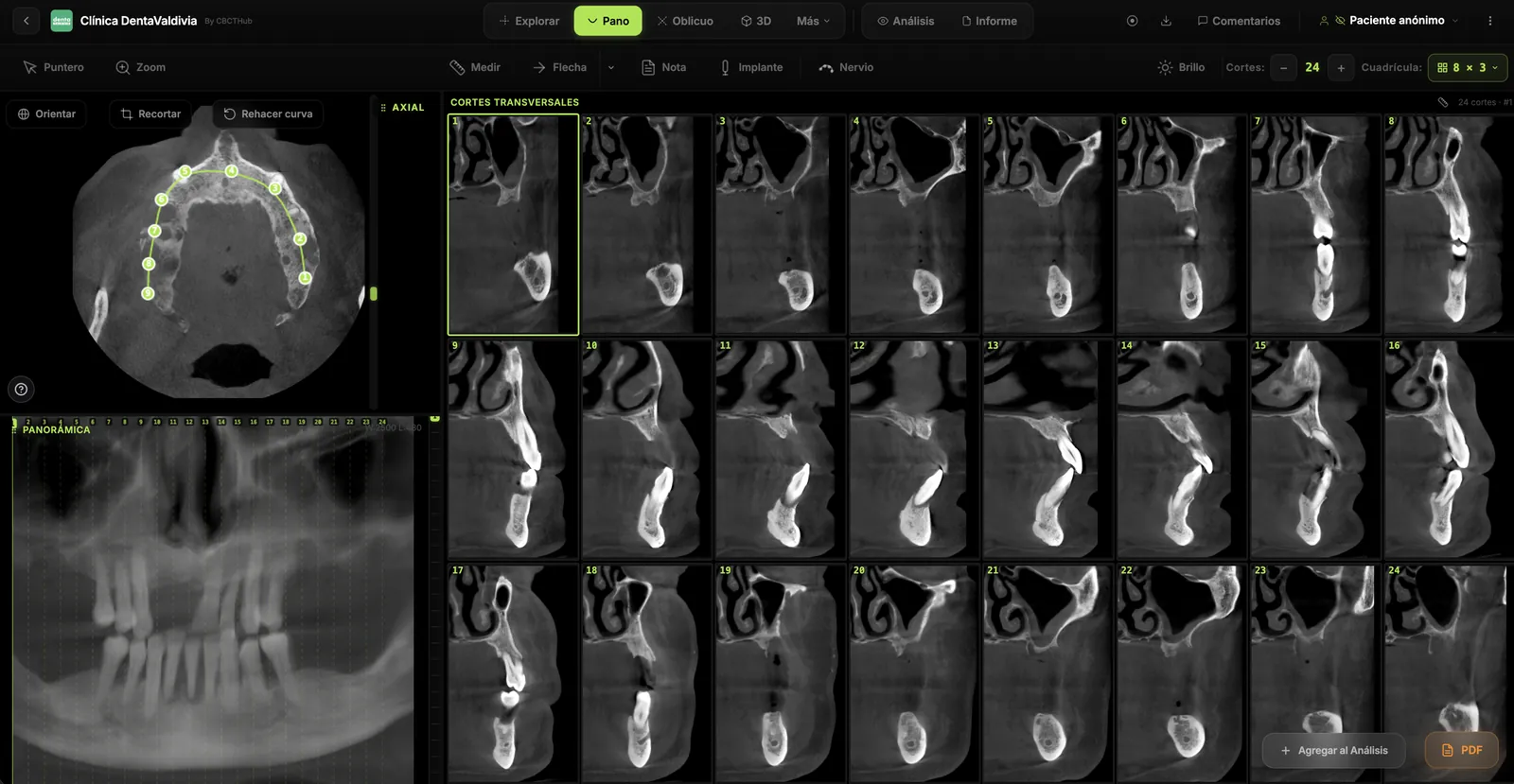
Most viewers let you annotate the canal course with a spline or series of points. Once annotated, the canal shows up in every reconstructed view and helps you stay 2 mm away.
Step 6: design the surgical guide (optional)
If you're using a surgical guide, export the plan as an STL with the drill sleeves positioned correctly. Most scanner-native suites (Romexis Implant Planner, CS 3D Imaging Implant module, OnDemand3D) do this internally. Third-party software like coDiagnostiX or NemoStudio imports the CBCT + STL and exports the guide design.
Browser viewers currently don't handle guide design end to end — that stays on the desktop. But the measurement and site evaluation steps are fully accessible in the browser.
Step 7: document for the record
The medicolegal value of CBCT-guided implant planning is high. Your chart should contain:
- The DICOM study (archived, retrievable)
- Screenshots of each planned site with measurements labeled
- The inferior alveolar canal map
- The planned implant diameter, length, position and axis
- Patient signature on an informed consent referencing the specific surgical plan
A shareable viewer link can serve as the archive: it's dated, authenticated, and retrievable years later without fishing through CD stacks.
Common mistakes
- Planning in axial only. Always confirm in an oblique cross-section along the intended implant axis.
- Relying on HU for density. CBCT voxel values are not calibrated HU; they vary between machines.
- Ignoring the lingual concavity in the posterior mandible. Perforation here is a known complication.
- Forgetting to verify tooth #18/48 extraction sites have healed before planning adjacent implants.
- Using a CBCT older than 12 months for surgical planning in a bone-modeling site. Re-scan if the bone may have changed.
Summary
CBCT for implant planning is a seven-step workflow: acquire the right scan, verify quality, plan the prosthesis first, measure critical distances, map vital structures, design the guide, document for the record. Each step takes minutes, not hours, once you're practiced.
The goal is to make surgery boring. The 30 minutes you spend planning on the CBCT save 2 hours in the chair and years of complications. Do it every time.
Try CBCTHub for free
Upload, view, and share DICOM scans in the cloud. Nothing to install.
Create free accountRelated articles
How to Measure Your CBCT Image Quality: A Technical Checklist for Your Team
Voxel size, FOV, contrast, noise, and artifacts. How to audit your center's image quality every month without expensive equipment.
How Much It Really Costs to Burn a CD to Deliver a CBCT Scan
A full TCO breakdown of CD-based CBCT delivery: consumables, staff time, patient callbacks, and redeliveries. The real numbers per study.
Dental CBCT in the cloud: day-to-day storage and sharing in clinic
What “CBCT in the cloud” means in clinic: store the original DICOM, access it from multiple chairs, and share with access control — without mistaking it for a full PACS or a WhatsApp ZIP.