Browser-Based DICOM Processing: How WebAssembly Changes Everything

· Updated

Understanding WebAssembly
WebAssembly (WASM) represents a revolutionary technology for web-based medical imaging. WebAssembly DICOM processing enables complex image manipulations historically possible only in desktop applications to run efficiently in modern web browsers.
WebAssembly is a binary instruction format and virtual machine allowing code written in C++, Rust, or other languages to run in web browsers at near-native performance. This opens new possibilities for sophisticated medical imaging software delivered entirely through the browser.
Traditional Limitations of Browser-Based Imaging
Before WebAssembly, browser-based medical imaging faced significant performance constraints:
- JavaScript alone was too slow for processing large volumetric datasets
- Complex algorithms like volume rendering or image reconstruction were impractical
- Users had no choice but to rely on desktop applications for advanced features
- Even displaying DICOM images required server-side processing
WebAssembly Performance Advantages
WebAssembly delivers performance comparable to native applications while remaining accessible through any web browser:
- 10-50x Faster: WASM code runs at speeds approaching native C++ applications, easily handling complex image processing tasks.
- Efficient Memory Usage: Direct access to allocated memory spaces allows optimal memory management for large volumetric datasets.
- GPU Acceleration: WebAssembly can interface with WebGL and WebGPU, enabling GPU-accelerated rendering comparable to desktop graphics applications.
- Multi-threaded Processing: Web Workers enable parallel processing on multiple CPU cores, distributing computational load.
Browser-Based DICOM Processing Capabilities
WebAssembly enables browser DICOM viewer applications to perform sophisticated processing entirely client-side:
Volume Rendering: Real-time 3D rendering of CBCT volumetric data, enabling interactive rotation, zoom, and examination from all angles.
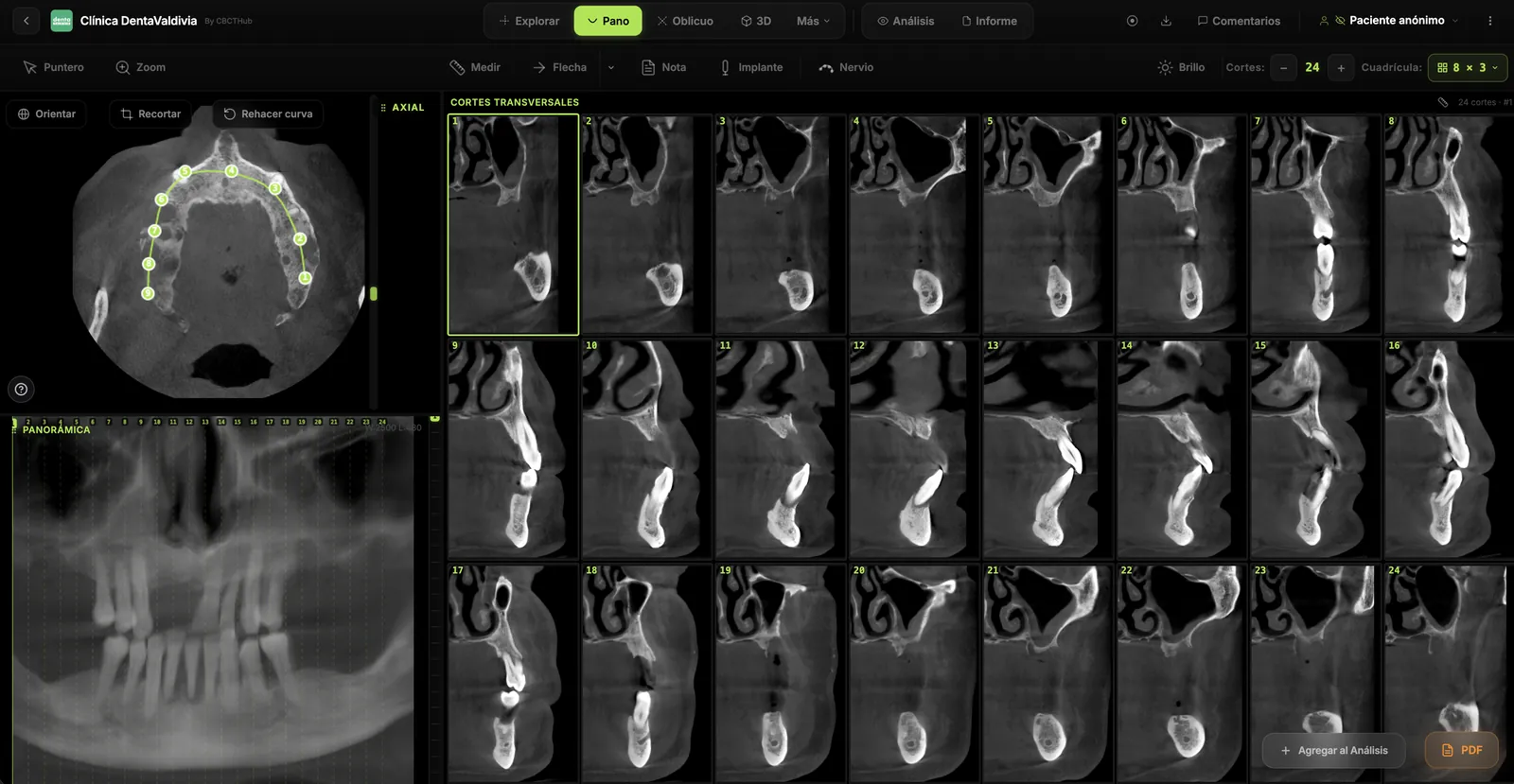
Multiplanar Reconstruction: Generate axial, sagittal, and coronal views on-demand from volumetric data without server-side processing.
Advanced Filtering: Apply sophisticated image enhancement algorithms—edge detection, artifact reduction, adaptive filtering—enhancing image quality for diagnosis.
Measurement Tools: Perform accurate linear and angular measurements with real-time feedback, essential for treatment planning.
Image Registration: Overlay and register multiple imaging modalities or serial studies for comparison analysis.
Segmentation: Advanced algorithms can segment anatomical structures or pathology, useful for surgical planning or research applications.
Privacy and Security Benefits
Client-side WebAssembly processing offers significant privacy advantages:
- Minimal Data Transmission: Compressed DICOM files are transmitted once; all processing occurs locally on the user's device.
- Reduced Server Load: Servers don't process sensitive patient data, reducing security risk.
- Offline Capability: Once DICOM files are downloaded, users can view and process them without internet connectivity.
- User Control: Processed images exist only temporarily in user's browser memory; nothing is retained on servers.
Practical Applications in Dental Imaging
Real-Time Consultation: Dentists access CBCT studies through a web browser, perform measurements and adjustments in real-time, and discuss cases with specialists without installing desktop software.
Patient Education: Patients view their own imaging through a browser-based platform, rotating 3D models and understanding their anatomy and planned treatment.
Radiology Workflows: Radiologists process and analyze CBCT studies using browser-based tools, eliminating the need for expensive workstation hardware.
Mobile Access: Tablet and smartphone browsers can view and process DICOM data, enabling remote consultations and emergency case review.
Current and Emerging WebAssembly DICOM Libraries
Cornerstone.js: Open-source library for displaying medical images in web browsers, now enhanced with WebAssembly capabilities.
VTK.js: Port of the popular Visualization Toolkit to JavaScript/WebAssembly, enabling advanced 3D visualization.
OHIF Viewer: Open Healthcare Imaging Foundation's web-based viewer built on modern frameworks with WebAssembly support.
Custom Implementations: Many imaging software companies now offer WebAssembly-enhanced versions of their products.
Limitations and Considerations
While WebAssembly is transformative, some limitations remain:
- Browser Memory Limits: Very large volumetric datasets may exceed available browser memory.
- Variable Performance: Performance varies across browsers and devices; not all machines are equally capable.
- Development Complexity: WebAssembly development requires specialized expertise and more complex debugging than traditional web development.
- Hardware Dependency: Full benefit requires modern browsers and reasonably capable hardware.
The Future of Browser-Based Medical Imaging
WebAssembly adoption in medical imaging is accelerating. Future enhancements will include:
- Improved GPU integration through WebGPU
- Better hardware acceleration
- Increased library support and standardization
- Enhanced security and regulatory compliance frameworks
- Seamless integration with AI/machine learning tools
Conclusion
WebAssembly represents a fundamental shift in web-based medical imaging. By enabling sophisticated image processing to occur efficiently in web browsers, WASM eliminates barriers between desktop and browser-based applications. For dental professionals, this means powerful imaging tools accessible from any device without installing specialized software. CBCTHub and similar platforms leverage WebAssembly to deliver professional-grade DICOM processing capabilities through simple, accessible web interfaces—representing the future of dental imaging software.
Try CBCTHub for free
Upload, view, and share DICOM scans in the cloud. Nothing to install.
Create free accountRelated articles
Browser DICOM viewer vs desktop: what works for CBCT in clinic
Open CBCT in the browser or install a desktop viewer? A clinical decision matrix: MPR performance, offline use, Mac/Windows mix, sharing without CDs, and when native software still wins.
Dental DICOM software: a checklist for choosing a CBCT viewer
Before adopting a dental DICOM or CBCT viewer in the clinic: checklist for interoperability, MPR, mm measurements, share without CD, privacy, and TCO.
Online CBCT viewer: what it is and when to use it in clinic
What an online CBCT viewer is, when to use it vs desktop or CD, DICOM tools (MPR, measurements, share link) and basic privacy in clinic.